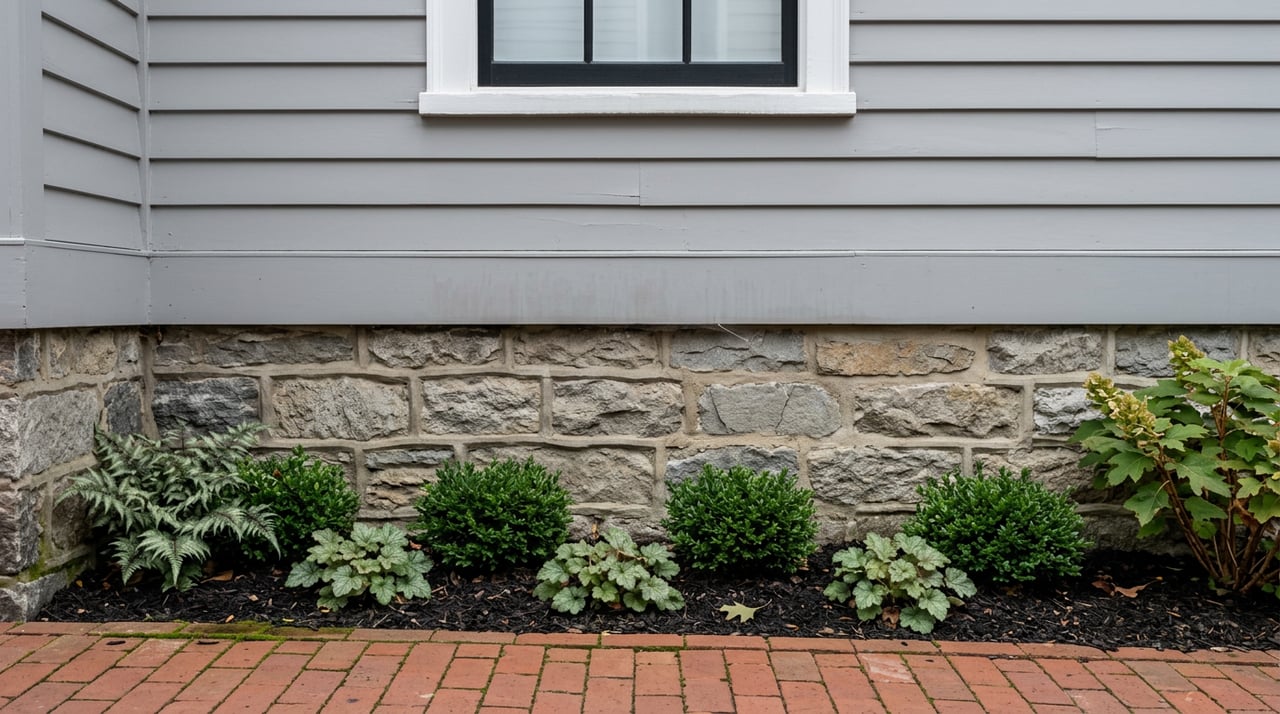
Ask around Bellefonte's historic core long enough and you'll hear a version of the same story. A homeowner notices dampness creeping up a fieldstone foundation wall, calls a contractor, and gets a straightforward answer: parge it, coat it, seal it, done. Then someone mentions that the house sits inside the borough's Local Historic District, and the straightforward answer gets a lot longer.
That collision is the thing most guides to buying or selling in Bellefonte skip. They'll tell you the town has Victorian architecture and a historic district. They'll tell you Pennsylvania requires a seller disclosure form. What they won't connect is that the exact geology responsible for so much of this town's character, the limestone bedrock that gave Bellefonte its name and its natural spring, is also the reason foundation moisture shows up so often in its oldest housing stock. And the fix for that moisture is precisely the kind of exterior, street-visible change the borough's Historic Architectural Review Board treats as untouchable without a hearing.
If you're preparing to list a home inside the district, or you're under contract on one, that overlap is worth understanding before a contractor's estimate turns into a six-week delay.
What Actually Triggers a HARB Review
Bellefonte's Historic Architectural Review Board reviews any exterior change to a building visible from a public street or right of way within the Local Historic District. That's the trigger: visibility from the street, not the size or cost of the project. The Building Code Official cannot issue a permit for erection, reconstruction, alteration, restoration, demolition, or even a new fence in the district until HARB has reviewed the proposal and Borough Council has issued a Certificate of Appropriateness.
The borough adopted updated Historic District Design Guidelines in January 2025, and they spell out what HARB is likely to approve and what it isn't. Masonry gets particular attention. The guidelines state plainly that stone and brick should not be removed or covered with artificial or synthetic materials, and that painting stone or brick is decided case by case rather than assumed to be fine.
That single line matters more than it looks like it should, because a synthetic waterproof coating or a modern parge job is often exactly what a foundation contractor recommends for a damp stone wall. In most Pennsylvania towns, that's a weekend fix. In Bellefonte's historic core, it's a conversation with the HARB administrator first, potentially followed by a formal application and a board meeting, before any work begins. New construction and larger projects go through a three-phase review process, and each phase has to happen at a separate HARB meeting, which stretches out a timeline that a seller or buyer might have assumed was a single trip to the borough office.
None of this means the work can't get done. HARB is an advisory board making recommendations to Council based on the Secretary of the Interior's Standards, and the borough's own guidance is to call the Historic Preservation Consultant before finalizing plans or putting down a contractor deposit. The point is timing. A seller who assumes exterior repairs can happen fast and cheap right before listing may be wrong on both counts.
The Bedrock the Whole Town Sits On
Bellefonte's name comes from its spring, and the geology behind that spring is the same reason foundation and drainage issues turn up as often as they do in the borough's older homes. Local foundation repair contractors who work across Centre County describe Bellefonte specifically as a town built on limestone springs, where that karst geology continues to push groundwater against foundations in ways that show up as settling, basement moisture, and cracked masonry in older construction.
Karst terrain forms when slightly acidic groundwater slowly dissolves limestone or dolostone bedrock, carving underground channels and, over time, opening sinkholes at the surface. Pennsylvania's Department of Conservation and Natural Resources notes that this process has shaped Centre County's landscape over hundreds of millions of years, and the same drainage network that produces natural springs also means water tends to move through the ground here more actively than it does on non-carbonate bedrock.
For a house built in the 1870s or 1890s, sitting on a fieldstone foundation with a century and a half of groundwater passing beneath it, this isn't an abstract geology lesson. It's a plumbing problem written into the bedrock. And it's a problem whose most common repair techniques run straight into the district's masonry guidelines.
Where the Two Frictions Meet
| If you're planning to... | The karst-geology reality | The HARB reality |
|---|---|---|
| Coat or parge a damp stone foundation | Common repair for limestone-adjacent moisture | Guidelines discourage covering stone with synthetic materials; case-by-case review |
| Regrade or add drainage visible from the street | Karst areas are sensitive to changes in surface water flow | Any street-visible alteration requires a Certificate of Appropriateness |
| Add a fence or exterior structure | Not geology-related, but common alongside drainage fixes | Building Code Official cannot issue a permit without prior HARB review |
| Test for radon | Central PA's limestone and shale formations vary, with some areas testing high | Not a HARB issue at all, this one runs through the state disclosure law instead |
That last row is its own separate track, and it's worth walking through on its own.
The Radon Question Nobody Is Required to Ask First
Pennsylvania's Real Estate Seller Disclosure Law is built around what a seller already knows, not what a seller is required to find out. Under the law, a seller's duty to disclose material defects lives at one section of the statute, and the disclosure form itself, including radon as a listed hazardous substance category, is governed by another. The practical result is that a seller who has never tested for radon has nothing to disclose, because the law does not compel testing before listing. Once a test has been performed, though, the results can't be withheld, and knowing omission of elevated results exposes a seller to statutory penalties.
The Department of Environmental Protection has said Pennsylvania has one of the more serious radon problems in the country, with an estimated 40% of homes tested statewide showing levels above the EPA's action guideline of 4.0 picocuries per liter. Central Pennsylvania's limestone and shale formations vary widely on this, with some homes testing low and others testing high enough to warrant a mitigation system. There's no way to know which category a specific Bellefonte home falls into without a test, and because the law doesn't require one, the oldest homes in the district, the ones least likely to have ever been tested, are often the ones carrying the most uncertainty into a sale.
For a seller, that uncertainty cuts in a specific direction. Testing before listing and getting a clean result means you enter the market with a documented answer instead of an open question. Testing and finding an elevated result gives you the option to install a mitigation system on your own timeline instead of during a buyer's inspection contingency, when the numbers become a negotiating point at the moment you have the least leverage.
What This Means for the Numbers You're Seeing Online
If you've been watching Bellefonte's median sale price bounce around depending on which site you check, that's not a data error. It's a symptom of a small market. One portal's snapshot from early 2026 put the median around the high $200,000s with a sharp year-over-year jump, while other trackers looking at different months in the past year and a half have landed anywhere from the low $300,000s to the high $300,000s. In a borough where only a handful of homes close in a given month, one or two high-end historic-district sales, or one or two distressed sales, can swing the median by tens of thousands of dollars without reflecting any real shift in what typical buyers are paying.
That volatility is exactly why a single headline number is the wrong tool for pricing a specific historic-district property. What actually moves value here is condition, and condition in this district is inseparable from whether a home's exterior repairs have already cleared HARB or still need to.
Before You List, or Before You Waive a Contingency
If you're selling a home in the district, the sequence that avoids surprises looks like this: call the HARB administrator before you commit to any exterior repair a stager or contractor recommends, especially anything touching masonry, drainage, or fencing. Decide whether a pre-listing radon test makes sense given your home's age and history. Document any prior repairs, HARB-approved or otherwise, since the disclosure form asks about known defects even if they were already fixed.
If you're buying, build a radon test into your inspection contingency as a named item, not an assumption folded into the general inspection, and ask directly whether any exterior work the seller has done or plans to do has gone through HARB. A verbal promise to "take care of it before closing" means something different in this borough than it does two miles outside the historic district line.
A Few Questions Worth Asking Directly
Does every exterior change in the historic district need HARB approval? Only if it's visible from a public street or right of way. Interior work and changes hidden from public view fall outside HARB's scope entirely.
Is radon testing required before I can sell my home in Pennsylvania? No. The law requires disclosure of test results you already have, not that you generate new ones. Testing is a strategic choice, not a legal obligation.
Does a historic designation hurt resale value? The borough's own guidance argues the opposite, framing design review as something that helps protect and enhance property values by keeping the district's collection of architectural styles intact. Whether that holds for a specific property depends on how well its prior owners navigated the approval process, which is exactly the kind of detail worth asking about before you write an offer.
If you're weighing a purchase or a sale inside Bellefonte's historic core and want a clearer read on how a specific property's condition and approval history line up, Annette Yorks Group can walk through it with you. Let's make your next move.